

Label additional text
Label – a paper, synthetic, textile, metal or other material attached to a product and printed with information about the product.
In some cases, self-adhesive labels are indispensable, in others, they simply make your company easier to work with, increase employee efficiency, and make it easier to collect and store information.
We tailor labels to the nature of each customer’s work and offer a wide range of colours: white, background, multi-colour, fluorescent, printed (barcodes, logos, branding, etc.), metallised, RFID.

There are several things to consider when choosing labels:
- Label and reel size required:
- Physical shape of the label (rectangular, oval, special notches, etc.);
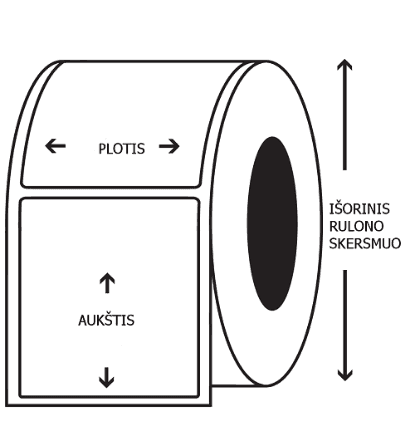
- Label dimensions (width x height, in the tables the first number is always the width, in
the second number is the height depending on the wrapping of the roll, see illustration); - Orientation of the label on the web, direction of wrapping, number of labels in a row;
- Inner diameter of the spool nozzle (depending on the configuration of the printer used);
- Outer diameter of the spool (depending on the configuration of the printer used);
- Label and reel size required:
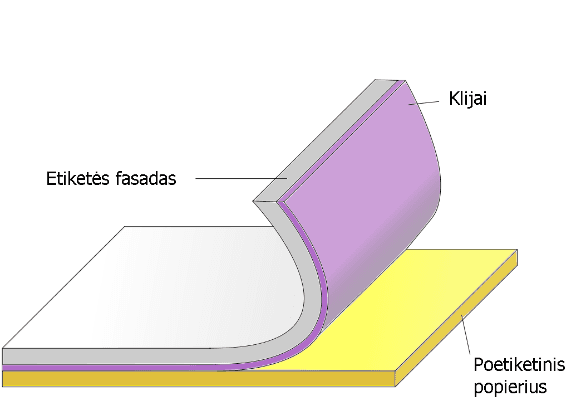
2. The raw material from which the label is made, see illustration:
2.1. Label facestock
Vellum – the most widely used uncoated matt all-purpose paper for the production of adhesive labels. The surface of this paper has a texture similar to that of standard office paper. Printed with a dye strip. It is an economy-grade raw material for information, logistics and other label applications.
Thermal Eco – the paper is coated with a special heat-sensitive layer that darkens when heated, eliminating the need for a ribbon and simplifying the printing workflow. Since labels made from this raw material lose their properties when exposed to high temperatures, UV rays and mechanical stress, they are mainly used for general-purpose information labels for short-term use. The price category is similar to Vellum labels printed with ink ribbon, the main advantage of these labels is the simple working process and the possibility to use them in portable and compact printers.
Thermal Top – Like Thermal Eco, this paper is coated with a special heat-sensitive layer and an additional protective layer that makes Thermal Top labels more resistant to environmental influences than Thermal Eco. Labels made from this raw material are more durable, making them ideal for printing on portable printers and even for use in the warehouse. The price point is higher than Vellum with ink ribbon, with the advantage of a simpler workflow and the possibility of using portable and compact printers.
Polypropylene film (PP) – labels made from this raw material are suitable for use on smooth surfaces where greater resistance to mechanical, water and chemical attack is required. The film is strong, tear-resistant and waterproof. The print is long lasting. Available in monochrome, translucent, glossy, matt. Of the synthetic raw materials, PP labels have the lowest price category.
Polyethylene film (PE) – PE labels are similar to PP labels, the main difference being that PE raw material is soft and elastic, making PE labels suitable for use on moving surfaces such as shampoo bottles etc. Available in monochrome, translucent, glossy, matt. PE labels have a higher price category than PP.
Cardboard – non-adhesive matt/semi-matt relatively thick and stiff paper (~200 gsm). Printed with thermal printers or flexographic printing. This raw material is used for the production of hanging labels, tickets, flyers of an informative nature.
Synthetic paper – non-adhesive synthetic paper, which can be made from polypropylene (PP), polyethylene (PE) or polyolefin. Printed with thermal printers or flexographic printing. Synthetic paper is resistant to mechanical stress, temperature, humidity and chemicals. Main applications: hanging information labels, tickets.
Inkjet raw materials – High-quality inkjet printing requires a special coating on the raw material that allows the ink to dry quickly. We can offer you similar raw materials to those listed above, which are suitable for inkjet label printers.
2.2. Adhesives
Standard permanent – the most popular adhesive, it adheres to most surfaces and is suitable for use at temperatures between -20°C and 80°C, but can only be applied at positive temperatures. When attempting to remove the adhesive label, the label facade is often damaged and/or traces of the adhesive remain on the surface. These adhesives are in the lowest price category.
Removable – labels with this adhesive can be easily removed from the surface on which the label is applied, leaving no residue. These labels are ideal for temporary labelling and for situations where the label is applied directly to the product, e.g. glassware, crockery.
High tack – strong adhesion elastic adhesive, used when particularly strong adhesion to the surface is required. Removal of the label from the surface is difficult, the label face is damaged and a significant trace of adhesive is left.
Deep-freeze – an adhesive suitable for bonding and use at sub-zero temperatures. Please note that although these adhesives can be used at sub-zero temperatures, the surface must be clean and dry and the label will not adhere if it is stuck on frost.
Special – if your job requires a special performance adhesive, contact us and we’ll help you choose the best option. The main characteristics of adhesives are initial adhesion, permanent adhesion, application and bonding temperatures. For example, an adhesive may have a weak initial adhesion, but after a few hours it migrates to the surface to form a strong adhesion layer.
2.3. Liner paper
Technological silicone or wax-coated paper for the transport of self-adhesive labels, i.e. the self-adhesive labels are presented in roll form on a strip of poetic paper. The silicone layer makes the labels easy to peel off from this tape. Standard poetic paper is single-sided silicone-coated and the most common colours are yellowish and white. The colour of the poetic paper has no effect on the label itself, but has a minimal effect on the operation of the label tracking sensor in the printing devices, so that different colours exist in practice.
Why work with us?
Lorem ipsum dolor sit amet, consectetur adipiscing elit. Aliquam ultrices nunc a ipsum maximus laoreet sit amet ac mauris. Pellentesque massa lacus, dapibus sed arcu eu, congue porttitor purus. Donec non vehicula enim. Fusce in lectus condimentum massa tincidunt rhoncus.
- We will reply within one working day
- Your question will be forwarded directly to the person responsible